
Cycle syncing has become more popular in the last year and is a great way to make the ebbs and flow of your cycle feel like less of a nuisance and more like an extra tool in your toolbox. It has helped me anticipate how I’m going to feel at certain times during the month so that I can better organize my life and minimize stress.
What is Cycle Syncing?
Cycle Syncing is looking at the way you plan your life within the context of your menstruation cycle and adjusting it to better meet your needs. Whether it’s 28 or 32 days long, women’s hormone cycles are vastly different than men’s, where their hormones typically cycle on a 24-hour schedule. Unfortunately, many aspects of modern-day society function on the latter which means women have been adapting to societal norms built for a man’s hormone cycle for years, not realizing how it may affect our health. For example, a consistent 5-day, 8-hour work week seems very realistic and obvious for someone who functions on a 24-hour hormone cycle, because they’re pretty consistent in how they feel physically and emotionally from day-to-day. However, for someone who is on a 28-day cycle, you’re likely going to have two good weeks (follicular phase), followed by one not-so-good week (luteal phase), and then one terrible week (menstruation). If we know this is going to happen each month, why don’t we better plan for it so we’re not feeling so miserable? While I wish I could tell you to take a week off from work every month for your period, we all know that currently isn’t realistic for most people, but it is possible to find a balance. Taking small steps to adjust your daily routines and habits to support your cycle may help you better manage stress and anticipate changes in how you feel throughout each phase of your cycle.
Think of it as optimizing your health. For example, if you know you’re going to get your period around the 15th of the month and you regularly experience cramping the day before and day of your period, you could block those days off in your calendar each month as days you’re not going to make any plans with friends. Instead, you could reserve those days as time for yourself and plan to stay home and focus on self-care and rest to ease the pain and manage fatigue. That way, when the cramps come, you:
a) aren’t having to cancel on friends and feel guilty or sad that you’re missing out,
b) have plans to take care of yourself, and
c) are giving your body the crucial rest and care it needs during this phase of your cycle.
Another example of how cycle syncing can help you optimize your health is planning your most intense workouts during the week of ovulation, when testosterone is spiking and you’re feeling your absolute best. This is a great time to really go hard in your workouts because the increase in testosterone is helping to aid in muscle growth, and the rise in estrogen is helping you feel good.
Why I Started Cycle Syncing
While on a quest to start understanding my body and more specifically, my hormones, I discovered the concept of cycle syncing. It was a foreign concept to me because my entire life I had subscribed to the belief that I needed to be consistent and disciplined to see results, whether that was in my physical health, mental health, career, or relationships. I had no understanding of what it meant to give myself grace and so I would push myself to my limits at all costs, all the time. It drove unrelenting expectations of myself that would result in burnout and self-shaming when I’d fail to achieve a certain goal or let someone down. Cycle syncing taught me that there is a time to go hard and there is also a time to rest, and that if you start to better recognize and support those periods with the necessary care then you’re more likely to effectively reach your goals and feel good while doing it.
When I began cycle syncing, my hormones were completely unbalanced partly because I had recently stopped taking hormonal birth control after 13 years, and because of years of not listening to what my body truly needed. As I began implementing the concept into different areas of my life, I found that it provided more balance and ease, making the ups and downs of my hormone cycle feel less intense and unexpected. I started to feel more in tune with my body and what it needed, recognizing that on the days leading up to my period I would feel much more introspective and tuned into my emotional state.
How to Start Cycle Syncing
There are many ways to start cycle syncing, but the most important thing you need to know first is how your hormones change throughout the month. The below graph depicts the fluctuations of a typical 28-day cycle, highlighting the two main phases as well as ovulation. If your cycle isn’t exactly 28 days, you can use an app to understand exactly when your hormones start to shift and plan accordingly. I have been using the Stardust app, which I find helpful for understanding my cycle and tracking symptoms throughout the month.
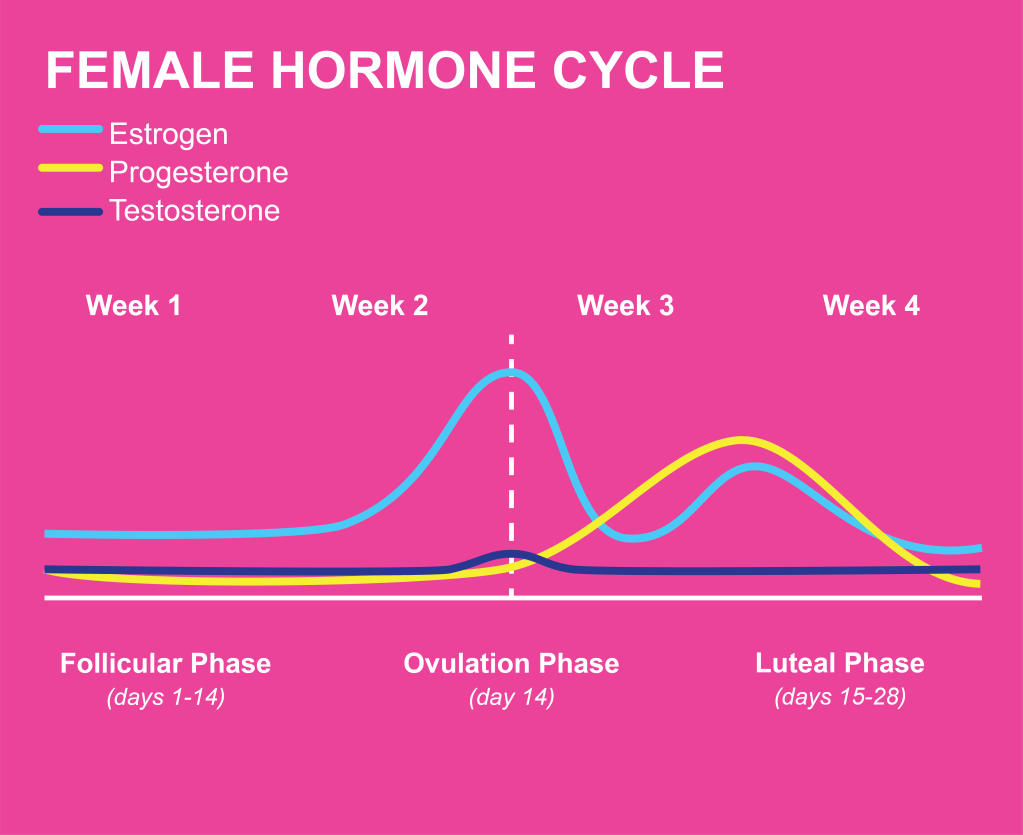
Once you have a good understanding of your cycle, you can start with almost any area of your life and fine tune it to better suit the way your hormones’ fluctuate.
Cycle Syncing Your Diet
When I first started cycle syncing, I started with my diet and worked on aligning it more with the nutritional needs of my body during each phase of my cycle to help boost energy and reduce uncomfortable symptoms. I recommend starting with a cookbook to help guide nutritional recommendations for each phase. I used the Moon Cycle Cookbook which is written by a nutritionist and offers great recipes and information on how each ingredient helps to support your body’s needs. From there, you can start to create meal plans accordingly.

What I’ve found to be consistent about my cycle, is that during my follicular phase my appetite is almost non-existent and I get full very quickly, sometimes to the point where I’m not consuming enough calories and nutrients for my body. On those days, I utilize smoothies as a way to add in extra nutrients like chia seeds, flax seeds, protein powder, black beans (yes, beans can be a great smoothie add in) or oats. Whereas when I’m in my luteal phase I am more likely to be ravenous and sometimes resort to the easiest and most appealing option, sugar. When I know this part of my cycle is coming, I try to have whole grain and healthy fat options available to prevent me from reaching for chocolate, and to properly fuel my body. Whole grains help provide vital nutrients for your body like energy and fiber while it’s gearing up to shed the inner lining, as well as keep you fuller for longer. Healthy fats can help satiate your cravings and those with omega-3’s have anti-inflammatory properties to ease menstruation symptoms.
Sometimes you might just actually need some sugar to relieve the craving and that’s totally fine. If that’s the case, then try to prioritize eating a well-balanced meal first, incorporating fiber, healthy fats, whole grains, and protein, so that you don’t cause an intense blood glucose spike.
Cycle Syncing Your Sleep Routine
Research shows that sleep disturbances are likely to occur during the premenstrual and menstrual periods of a woman’s cycle, resulting in lower quality or lack of adequate sleep. Additionally, your body is using extra energy to shed the inner lining of your uterus, which means it’s going to need more sleep during the luteal phase. Accounting for this can make all the difference in your ability to function throughout the course of a day.
On the opposite side of this, in your follicular phase you may find you can get away with less sleep and still feel fantastic, even when you’re going hard in your workouts and other areas of your life. As you begin to take note of the differences between one end of the month and the other, you can plan your sleep cycle to be better supported during each phase. That could mean during your luteal phase you prioritize getting an extra hour of sleep, so you can feel rested and ready to take on the day.
Cycle Syncing Your Fitness Routine
During my ovulation phase I was surprised to find that I could workout 7 days in a row at high intensity with little to no fatigue, but as I entered my luteal phase doing high intensity workouts became very challenging and I would constantly feel exhausted and experience heart rate spikes. Shifting the intensity of my workout and learning to back off when my body needs more rest helps with recovery and feeling better. Incorporating more intense workouts during my follicular and ovulation weeks, like heavy weightlifting and HIIT workouts, and pulling back on my workouts in the week leading up to and during my period helps me feel more in control of my workout goals. I am able to be more consistent and have more effective workouts as a result, allowing me to maximize my progress.
Cycle Syncing Your Sex Life
Whether you are trying to have a baby or are not, this area of cycle syncing can seem pretty obvious. However, there are other hormonal changes that you can capitalize on to really dial in your sex life. Did you know that your cervix moves throughout the course of your cycle? This means that sex is likely going to feel different at every phase, and it’s possible that some positions may feel more enjoyable at certain times of the month as a result. Consider tuning into the positions you perform most often and note how they feel at each phase. Reverse cowgirl may not feel like anything special during your luteal phase, but it could feel incredible during your follicular phase. Noting these nuances and using them to your advantage can help sex feel more exciting and allow you feel more playful and empowered, giving you more control over your sexual experiences.
Getting Started
All of this can easily feel overwhelming when first getting started, so I recommend starting with one thing and adding in more each month when you feel ready. Also, remember that cycle syncing is unique to each person, so something that works for one person may likely not work for others. Always listen to your body and trust your gut as you venture into this practice. If cycle syncing is something you’re interested in doing, below are three tips to help you get started.
- Note your symptoms: we all experience different symptoms throughout our cycle, some more prominently than others, so spend some time noting what the common feelings are that you notice at different stages of your cycle. Once you have a good understanding you can start to explore ways to help support your body during each fluctuation.
- Take it slow: it’s very easy to get really excited about trying a new health practice and going all in, but because of how many areas of your life cycle-syncing can be incorporated into it’s important to take it slow and allow your body to adjust. I recommend starting with one new thing each month to allow your body time to respond and give you feedback, as well as help you adjust to the lifestyle changes. If you try to load too many changes at once, it’s going to feel overwhelming and you’re not going to be able to figure out what your body is responding to.
- Set realistic expectations: it’s important to note that you don’t have to sync every aspect of your life around your cycle, and even if you do, it’s ok to deviate from the plan. Cycle syncing is something you can do to help support your body, so if your needs end up being different from what you originally planned on doing that’s ok. This isn’t the time to have rigid expectations for yourself, it’s meant to help you get in tune with your body so you can better anticipate its needs.
I’d love to know…
Have you tried cycle syncing? If so, tell me about it in the comments!

 That B*tch Emily
Leave a comment